Showing posts with label WOMEN OF ISLAM. Show all posts


Bismillahi rahmani rahim

Assalam alaikum warahmatullah wabarakatu

This is a piece I came across, it is so inspiring I couldn't not share it.

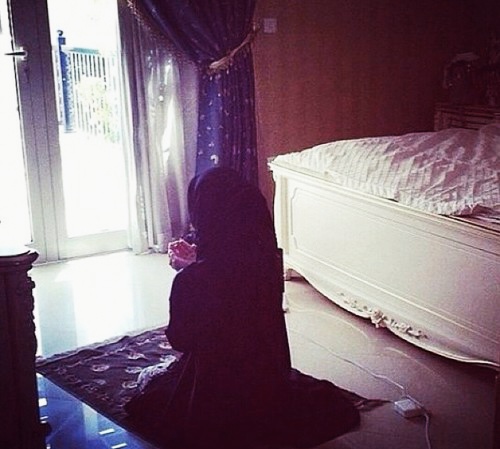
Her cheeks were worn and sunken, and her skin hugged her bones. That didn't stop her because you could never catch her not reciting Qur'an. She was always vigil in her personal prayer room that our father had set up for her. Bowing, prostrating, raising her hands in prayer, was the way she was from dawn to sunset and back again; boredom was for other people.

As for me, I craved nothing more than fashion magazines and novels. I treated myself to videos until the trips to the rental place became my trademark. It’s a saying that when something becomes habit, people tend to distinguish you by it. I was negligent in my responsibilities and my salah was characterized by laziness.

One night, after a long three hours of watching, I turned the video off. The adhan rose softly in the quiet night. I slipped peacefully into my blanket. Her voice called me from her prayer room. 
"Yes? Would you like anything Noorah?" I asked. 
With a sharp needle she popped my plans. 
"Don't sleep before you pray Fajr!" Agghh! 
“There's still an hour before Fajr. That was only the first adhan,” I said. 
With those loving pinches of hers, she called me closer. She was like that even before the fierce sickness shook her spirit and shut her in bed. "Hanan, can you come sit beside me." I could never refuse any of her requests; you could touch the purity and sincerity in her. 
"Yes, Noorah?"
"Please sit here."
"Alright, I’m sitting. What's on your mind?"
With the sweetest mono voice she began reciting: Every soul shall taste death and you will merely be repaid your earnings on the Day of Resurrection. She stopped thoughtfully. Then she asked, "Do you believe in death?" "Of course I do,” I replied.

"Do you believe that you shall be responsible for whatever you do, regardless of how small or large?"
"I do, but Allah is Forgiving and Merciful, and I’ve got a long life waiting for me." 
"Stop it Hanan! Are you not afraid of death and its abruptness? Take a look at Hind. She was younger than you but she died in a car accident. Death is age-blind and your age could never be a measure of when you shall die."

The darkness of the room filled my skin with fear. "I'm scared of the dark and now you made me scared of death. How am I supposed to go to sleep now? Noorah, I thought you promised you'd go with us on vacation during the summer break." Her voice broke and her heart quivered. "I might be going on a long trip this year Hanan, but somewhere else. All of our lives are in Allah’s hands and we all belong to Him."

My eyes welled and the tears slipped down both cheeks. I pondered my sisters grizzly sickness. The doctors had informed my father in private that there was not much hope Noorah was going to outlive the disease. She wasn't told, so I wondered who hinted to her. Or was it that she could sense the truth?

"What are you thinking about Hanan?" Her voice was sharp. "Do you think I am just saying this because I am sick? I hope not. In fact, I may live longer than people who are not sick. How long are you going to live Hanan? Perhaps twenty years? Maybe forty? Then what?" Through the dark she reached for my hand and squeezed gently. "There's no difference between us; we're all going to leave this world to live in Paradise or agonize in Hell. Listen to the words of Allah: Anyone who is pushed away from the Fire and shown into Jannah will have triumphed.

I left my sister's room dazed, her words ringing in my ears: “May Allah guide you Hanan - don't forget your prayer.” I heard pounding on my door at eight o'clock in the morning. I don't usually wake up at this time. There was crying and confusion. O Allah, what happened? Noorah’s condition became critical after Fajr; they took her to the hospital immediately.


"Inna lillahi wa inna ilayhi raji'oon"

There wasn't going to be any trips this summer. It was written that I would spend the summer at home. It felt like an eternity had gone by when it was one o'clock in the afternoon. Mother phoned the hospital. "Yes. You can come and see her now." Dad's voice had changed, and mother could sense something had gone deathly wrong. We left immediately.

Where was that avenue I used to travel and thought was so short? Why was it so very long now? Where was the cherished crowd and traffic that would give me a chance to gaze left and right? Everyone, just move out of our way!

Mother was shaking her head in her hands crying as she made du'a for her Noorah. We arrived at the hospital’s main entrance. One man was moaning, while another was involved in an accident. A third man’s eyes were iced. You couldn’t tell if he was dead or alive. Noorah was in intensive care. We skipped stairs to her floor. The nurse approached us. "Let me take you to her."

As we walked down the aisles the nurse went on expressing how sweet of a girl Noorah was. She somewhat reassured Mother that Noorah’s condition had gotten better than what it was in the morning. "Sorry. No more than one visitor at a time,” the nurse said. This was the intensive care unit. Past the flurry white robes, through the small window in the door, I caught my sister’s eyes. Mother was standing beside her. After about two minutes, mother came out unable to control her crying. "You may enter and say salaam to her on the condition that you do not speak too long," they told me. "Two minutes should be enough."
"How are you Noorah? You were fine last night sister, what happened?"
We held hands; she squeezed harmlessly. "Even now, alhamdulillah, I'm doing fine."
"Alhamdulillah...but...your hands are so cold."
I sat on her bedside and rested my fingers on her knee. She jerked it away. "Sorry, did I hurt you?"
"No, it is just that I remembered Allah's words.”
Waltafatul saaqu bil saaq (One leg will be wrapped to the other leg [in the death shroud]).
"Hanan pray for me. I may be meeting the first day of the Hereafter very soon. It’s a long journey and I haven't prepared enough good deeds in my suitcase."

A tear escaped my eye and ran down my cheek at her words. I cried and she joined me. The room blurred away and left us two sisters to cry together. Rivulets of tears splashed down on my sister’s palm, which I held with both hands. Dad was now becoming more worried about me. I've never cried like that before.

At home and upstairs in my room, I watched the sun pass away with a sorrowful day. Silence mingled in our corridors. One after another, my cousins came in my room. The visitors were many and all the voices from downstairs stirred together. Only one thing was clear at that point – Noorah had died! I stopped distinguishing who came and who went. I couldn't remember what they said. O Allah, where was I? What was going on? I couldn't even cry anymore.

Later that week they told me what had happened. Dad had taken my hand to say goodbye to my sister for the last time. I had kissed Noorah's head. I remember only one thing while seeing her spread on that bed – the bed that she was going to die on. I remembered the verse she recited: One leg will be wrapped to the other leg (in the death shroud). And I knew too well the truth of the next verse: The drive on that day will be to your Lord (Allah)!

I tiptoed into her prayer room that night. Staring at the quiet dressers and silenced mirrors, I treasured the person that had shared my mother's stomach with me. Noorah was my twin sister. I remembered who I had swapped sorrows with, who comforted my rainy days. I remembered who prayed for my guidance and who spent so many tears for many long nights telling me about death and accountability. May Allah save us all.

Tonight is Noorah's first night that she shall spend in her tomb. O Allah, have mercy on her and illumine her grave. This was her Qur'an and her prayer mat. And this was the spring, rose-colored dress that she told me she would hide until she got married; the dress she wanted to keep just for her husband.

I remembered my sister and cried over all the days that I had lost. I prayed to Allah to have mercy on me, accept me and forgive me. I prayed to Allah to keep her firm in her grave as she always liked to mention in her supplications. At that moment, I stopped. I asked myself what if it was I who had died. Where would I be moving on to? Fear pressed me and the tears began all over again.

“Allahu Akbar, Allahu Akbar…” The first adhan rose softly from the masjid. It sounded so beautiful this time. I felt calm and relaxed as I repeated the mu’adhin’s call. I wrapped the shawl around my shoulders and stood to pray Fajr. I prayed as if it was my last prayer, a farewell prayer, just like Noorah had done yesterday. It had been her last Fajr.

Now, and in sha Allah for the rest of my life, if I awake in the morning I do not count on being alive by evening, and in the evening I do not count on being alive by morning. We are all going on Noorah's journey. What have we prepared for it?


Muhammad Alshareef's final speech at the 1999 MYNA East Zone Conference.


Bismillah ir-rahman ir-rahim

Assalam alaikum warahmatullah wabarakatu 

So, when Musa a.s was born, his mother feared for his life. But Allah assured her that he would be safe and told her to place him in a boat on the Nile. The Quran tells us what’s translated as, “And we inspired to mother of Musa, saying, “Suckle him but when you fear for him, then cast him into the river and fear not nor grieve. Verily, We shall bring him back to you and shall make him one of our Messengers.”” And this is chapter 28 Verse 7.

And just as Allah had promised, Musa came safely to the shore where he was found by Asya. Asya then convinced her husband to keep the child. Allah tells us, “Then the household of Firaun picked him up that he might become for them an enemy and a cause of grief. Verily, Firaun, her man, and their hosts were sinners and the wife of Pharaoh said, “A comfort for the eye, for me and for you. Kill him not. Perhaps he may be of benefit for us and we may adopt him as a son. And they perceived not the result of that. This is also from Suratul Qasas verses 8-9.

So Musa grew under that protection of Asya, in the house of Firaun. Musa grew to be a great Prophet who called his people to the worship of one God. But because of the oppression of Firaun, many people did not believe in him. He would threaten people. He had gathered all of his henchmen and Firaun had announced that, “I am your Lord, most great.” And he threatened anyone who tried to not believe in him as the one true lord. 

What happened was for example when the magicians believed in the message of Musa, Firaun threatened them with a great penalty. He threatened to cut off their limbs. Their hands and their feet from opposite sides and then crucify them on tree trunks. So this was the punishment that he had given to those who believed. Yet, despite this persecution, Asya believed in Musa’s message and she held firm to her faith. That faith was so strong that she was willing to die for it. When Firaun found out that she believed, he tortured her severely. But her belief in God was so strong that it made her an everlasting symbol.

Allah subhanahu wa ta'ala says in the Quran what is translated as, “God sets forth an example for those who believe, the wife of Firaun who said, “My Lord, build for me with You a house in Paradise and save me from Firaun and his doings. And save me from an unjust people.””

Now think about this.

Asya was a queen. She was the wife of one of the most powerful man to walk the earth. She lived a life of unparalleled luxury and wealth. Yet, Asya knew that her true home was in Paradise. She had no attachment to this life.

Now, there are a lot of lessons we can learn from Asya’s life and from this in particular. But one of the really beautiful lessons for me particularly, from her story, is the fact that despite all the persecution that she was going through, Allah made it easy on her so much so that when she was being tortured she actually smiled. And the reason why she smiled was because Allah rabbul izza answered her dua and allowed her to actually see her home in Jannah.

The reason why I find this particularly moving is because, if Allah is with you, even your hardest struggles can become light. If you can see your home with Allah in Jannah, no matter what you are going through in this life, it can become easy. And what better example of that than this woman who’s being tortured by the worst man ever to walk the earth? Yet, she was able to bear it and she even smiled because Allah subhanahu wa ta'ala was with her and He made it easy for her. And she had a greater attachment to her home in Jannah than to her home here. And because of that, everything that she dealt with, regardless of how difficult it was, was made easy for her.

The second lesson which I think is very important is that she was married to a very tyrannical man who claimed to be the Lord right? Yet, she was not defined by him. Although he was her husband and although that was her circumstance, she was not defined or limited by those circumstances.

Now, this is an important lesson for us because all of us will have different things in life that are thrown at us. The question is: What are we going to define our self-worth by? So, we go through society and society tells you that you are supposed to get your self-worth, if you are a woman, by the way you look usually. By how many people think you are attractive, by how thin you are. There’s different places you are supposed to get your self-worth. But that’s one of the places society teaches women to get their self-worth. As men, they are told, a lot of times to get their self-worth by status, by wealth, how powerful you are.

The point here is that our self-worth should only come from one relationship. Only one relationship. And that’s the relationship with our Creator. Our relationship with our Creator should define how we feel about ourselves and who we are.

For Asya, that’s how it was. It was her relationship with her Creator. It wasn’t her relationship with the tyrannical person that she happened to live with or by her circumstances. 

The story of Asya is an everlasting example of a woman who chose the Hereafter over all of the glitter of this world. It is the story of a woman whose love of Allah and the home with Him was greater. It is the story of a woman whose faith inspired her to take on the greatest tyrant of all time. And to give her life in the process.

May Allah bless her work and grant her Jannah. Ameen


[Yasmin Moghade]


Bismillahi rahmani rahim 

Assalam alaikum warahmatullah wabarakatu 


This is my story of how I reverted to Islam, it's a story of plans. I made plans; the group I was with made plans, and Allah made plans. And Allah is the Best of Planners.

When I was a teenager, I came to the attention of a group of people with a very sinister agenda. They were and probably still are a loose association of individuals who work in government positions but have a special agenda — to destroy Islam. It is not a governmental group that I am aware of, they simply use their positions in the US government to advance their cause.

One member of this group approached me because he saw that I was articulate, motivated and very much the women’s rights advocate. He told me that if I studied International Relations with an emphasis in the Middle East, he would guarantee me a job at the American Embassy in Egypt. He wanted me to eventually go there to use my position in the country to talk to Muslim women and encourage the fledgling women’s rights movement.

I thought this was a great idea. I had seen the Muslim women on TV; I knew they were a poor oppressed group, and I wanted to lead them to the light of 20th century freedom.

With this intention, I went to college and began my education. I studied Quran, hadith and Islamic history. I also studied the ways I could use this information. I learned how to twist the words to say what I wanted them to say. It was a valuable tool.

Once I started learning, however, I began to be intrigued by this message. It made sense. That was very scary. Therefore, in order to counteract this effect, I began to take classes in Christianity. I chose to take classes with this one professor on campus because he had a good reputation and he had a Ph.D. in Theology from Harvard University. I felt I was in good hands. I was, but not for the reasons I thought. It turns out that this professor was a Unitarian Christian. He did not believe in the trinity or the divinity of Jesus. In actuality, he believed that Jesus was a prophet.

He proceeded to prove this by taking the Bible from its sources in Greek, Hebrew and Aramaic and show where they were changed. As he did this, he showed the historical events which shaped and followed these changes.

By the time I finished this class, my religion had been destroyed, but I was still not ready to accept Islam.

As time went on, I continued to study, for myself and for my future career. This took about three years. In this time, I would question Muslims about their beliefs. One of the Individuals I questioned was a Muslim brother with the MSA [Muslim Students’ Association]. Alhamdulllah, he saw my interest in the deen, and made it a personal effort to educate me about Islam. He would tell me about Islam at every opportunity which presented itself.

One day, this man contacts me, and he tells me about a group of Muslims who were visiting in town. He wanted me to meet them. I agreed. I went to meet with them after Isha [night] prayer. I was led to a room with at least 20 men in it. They all made space for me to sit, and I was placed face to face with an elderly Pakistani gentleman.

MashAllah, this brother was a very knowledgeable man in matters of Christianity. He and I discussed and argued the varying parts of the bible and the Quran until the fajr [dawn prayer]. At this point, after having listened to this wise man tell me what I already knew, based on the class I had taken in Christianity, he did what no other individual had ever done. He invited me to become a Muslim.
In the three years I had been searching and researching, no one had ever invited me. I had been taught, argued with and even insulted, but never invited.

So when he invited me, it clicked. I realized this was the time. I knew it was the truth, and I had to make a decision. Alhamdulillah [All praise be to Allah], Allah opened my heart, and I said, “Yes. I want to be a Muslim.”

With that, the man led me in the shahadah [the testimony of faith] – in English and in Arabic. When I took the shahadah, I felt the strangest sensation. I felt as if a huge, physical weight had just been lifted off my chest; I gasped for breath as if I were breathing for the first time in my life.

Alhamdulillah, Allah had given me a new life — a clean slate — a chance for Jannah [Paradise], and I pray that I live the rest of my days and die as a Muslim. Ameen.


[revert2islamtoday.blogspot.com]
Bismillah ir-rahman ir-rahim

Assalam alaykum warahmtullah wabarakatu

A friend of mine once shared the story of a young woman who had accepted Islam and fell sick shortly thereafter and was hospitalized. Her new Muslim companions would gather at her bedside reciting Qu’ran and keeping her company. One day one of the Muslims was reciting Qur’an and the woman started to turn her head back and forth in apparent agitation. Concerned, the Muslims asked what was wrong.

The sick woman responded by saying that it was hard to concentrate because she didn’t know whom to listen to.

“What do you mean?” the Muslims asked her.

Agitated, she said to the one reciting Qur’an, “Should I listen to you and should I listen to them?”

The reciter turned and didn’t see anyone. “I’m the only one reciting,” he said.

The woman, who did not know Arabic, responded saying, “I hear someone else saying, ‘Yaa ayyu han-nafsul mut-ma-innah. ‘Irji’ee ilaa rabbiki raaDiyya-tam marDiyyah. Fad-khulee fee ‘ebaadee, wad-khulee jannatee.”

O reassured soul, Return to your Lord, well-pleased and pleasing [to Him]. And enter among My [righteous]servants. And enter My Paradise (Qur’an; Al-Fajr , 89:27-30).

A moment later, she died…

When I heard the story of the girl hearing the last verses from Soorat Al-Fajr before death, my eyes welled with tears. I longed to hear those Divine words recited to me. But as I reflected on my life and my shortcomings, I wondered if I’d be given that gift.

What was it, I wondered, that she had done that pleased Allah so much that she earned this momentous blessing? Was there something—anything—that I could do to earn something similar?

I thought of my parents and my deeds what could I do to achieve such an ending.

[Umm Zakariya]


Bismillah ir-rahman ir-rahim

Assalam alaikum warahmatullah wabarakatu


The fruit of raising daughters righteously is reward in this life before reward in the Hereafter; this is proved by the fact that Allah rewarded the righteous man who raised his two daughters virtuously, the result being Him facilitating the marriage of one of them to the honourable Prophet Musa.


The Prophet sallallaahu 'alayhi wa sallam would express his love for his daughters by, for example, making statements like “(My daughter) Faatimah is a part of me, so whoever angers her angers me.” (Al-Bukhari & Muslim)

‘Aa'ishah recounted that Faatimah once came walking in a manner identical to that of the Prophet sallallaahu 'alayhi wa sallam; When she arrived, he stood up and exclaimed: “Welcome, my daughter!” Then, he seated her to his side and whispered into her ear, and what he had said caused her to cry; then, he then whispered to her again, and she laughed. 'Aa'ishah later asked her: "What made you weep and then laugh?" She replied: "I will never expose a secret that the Prophet entrusted me with." After the death of the Prophet 'Aa'ishah asked her the same questions again, so she answered: "First, he informed me that his death was near, so I cried. After that, he told me that I will be the leader of the ladies of Paradise, so I laughed." (Al-Bukhari & Muslim)


'Aa'ishah said: “I have not seen anyone closer in physical appearance and character to the Prophet than his daughter Faatimah. Whenever she would enter into his presence, he would  stand up and seat her in his place, and whenever he would enter into her presence, she would stand up, kiss him, and seat him in her place.”


This is how he cared for his daughters.

Zaynab who was another daughter of the Prophet sent for him due to her child being close to death, but the Prophet sent the  Messenger back to her, telling him to tell her: "Whatever Allah takes away or gives, belongs to Him, and everything with Him has a limited fixed term (in this world); and she should therefore be patient and anticipate Allah's reward.'' She sent for him again,  pleading with him for the sake of Allah to come. Therefore, the Messenger of Allah went, accompanied by Sa`d bin `Ubaadah, Mu`aath bin Jabal, Ubayy bin Ka`b, Zayd bin Thaabit and others . The child was lifted up to the Messenger of Allah while breathing heavily, in the last moments before his death. Upon seeing this, the eyes of the Prophet sallallaahu 'alayhi wa sallam streamed with tears as a result of compassion that Allah had placed in his heart. Due to this, Allah caused the boy to be cured, as Imaam Ibn Hajar stated. The Prophet sallallaahu 'alayhi wa sallam would carry Umaamah during prayer whilst standing, and place her on the ground before prostrating. (Al-Bukhari)

Once, Faatimah complained to him about suffering due to strenuous housework, and that it was causing her hands to roughen and  develop marks; he therefore taught her to mention Allah before going to bed by uttering 'Subhaan-Allaah' (i.e., glory be to Allah) and 'Al-Hamdulillaah' (i.e., all praise be to Allah) thirty- three times each, and thirty-four times 'Allaahu Akbar' (i.e., Allah is the Greatest); he told her that this would be better for her than theassistance of a servant.


Also, when the family of Abu Jahl requested ‘Ali to marry their daughter, he refused and said: “Never will the daughter of the  Mssenger of Allah and the daughter of the enemy of Allah be under (the guardianship of) one man. Faatimah is a part of me, and whoever saddens her has harmed me.” He later stood up and explained to the people that he was not making unlawful what Allah made lawful, nor was he forbidding polygamy, but rather, he did what he did due to Faatimah being the daughter of a messenger, which is a special case, since no one is permitted to harm the Messenger.

Faatimah was courageous and proud of Islam. In the incident when her father was praying in front of the Ka’bah and the disbelievers placed the guts of a camel on his head whilst he was prostrating and then laughed and mocked him, it was she who came, by herself, and screamed at the disbelievers and then removed the guts. (Muslim) This is how the life of the Prophet was regarding dealing with his daughters, so let us make it a guideline by which we live. 

Some people are truly hardhearted, to the point that they do not express any emotions toward their children. It is a disaster when a daughter is raised in such an emotional vacuum, because it is easy for any evil person to then affect her with his deceptive words and entice her into his trap, and this is how the calamity of fornication occurs. This is why we need to pay close attention to the issue of daughters and grant them their due consideration, especially when we live in an era where everything evil is available and within reach.


It is indeed a great responsibility to satiate the emotions of our daughters with the love they need from the hearts of their merciful fathers, lest evil men do this instead to achieve their vile objectives.


We must also give the same level of attention to our sons in this regard, because the problems we hear regarding our young men are due to the negligence of their parents. What is our role? It is, as Allah says (what means): “O you who have believed! Protect yourselves and your families from a Fire whose fuel is people and stones, over which are [appointed] angels, harsh and severe; they do not disobey Allah in what He commands them but do what they are commanded.” [Quran 66: 6]


We must soften their hearts with a warm smile whenever we see them, and speak to them with merciful words. If we do not pay attention to this issue, a day will come when our communities will be just like the immoral and dissolute ones. A British survey of two thousand fathers found that: “Forty-percent (40%) of fathers feel lonely and depressed. They miss their sons, but miss their daughters a lot more.” 

Some contemporary hypocrites who write in newspapers and magazines state that our daughters do not need guardians. They oppose to the Law of Allah in general, and specifically the ruling that prohibits intermixing between men and women; they demand that women leave their homes and 'prove their ability'. Why do these hypocrites wish to eradicate our honour? This mandates even more care and attention towards our daughters; we must raise them upon obedience to Allah and His messenger and upon adherence to the Hijaab; we must not wait till they reach the age of puberty to instruct them wear it, because it might then be too late for them to accept it.


Some parents allow their daughters to wear dresses that are revealing and which leave them naked, or almost naked, and this is a far cry from correct cultivation. It is not a reflection of love or mercy to our daughters to allow them to have their own mobile phone, or to have a satellite receiver in their rooms. It is not a sign of love or mercy to allow them to go to places where immorality is spread, or to parties, or salons where they pluck their eyebrows, adorn themselves and then go out like that.


We must convince our daughters that these matters are prohibited and that they must refrain from doing them, but in order to convince them, they must experience our love and see it in our dealings with them. The Daughters of Islam.

And Allah knows best.


Bismillah ir-rahman ir-rahim

Assalam alaykum warahmatullah wabatakatu

Another from Tafsir Ibn Kathir.

Allah will grant after hardship, ease. This is a sure promise from Him, and indeed, Allah’s promises are true and He never breaks them, this is an Allah’s saying. 

"Verily, along with every hardship is relief. Verily, along with every hardship is relief." [94:5-6]

There is a relevant Hadith that we should mention here. Imam Ahmad recorded that Abu Hurayrah said, “A man and his wife from an earlier generation were poor. Once when the man came back from a journey, he went to his wife saying to her, while feeling hunger and fatigued, `Do you have anything to eat’ She said, `Yes, receive the good news of Allah’s provisions.’ He again said to her, `If you have anything to eat, bring it to me.’ She said, `Wait a little longer.’ She was awaiting Allah’s mercy. When the matter was prolonged, he said to her, `Get up and bring me whatever you have to eat, because I am real hungry and fatigued.’ She said, `I will. Soon I will open the oven’s cover, so do not be hasty.’ When he was busy and refrained from insisting for a while, she said to herself, `I should look in my oven.’ So she got up and looked in her oven and found it full of the meat of a lamb, and her mortar and pestle was full of seed grains; it was crushing the seeds on its own. So, she took out what was in the mortar and pestle, after shaking it to remove everything from inside, and also took the meat out that she found in the oven.”

Abu Hurayrah added, “By He in Whose Hand is the life of Abu Al-Qasim (Prophet Muhammad )! This is the same statement that Muhammad said, (Had she taken out what was in her mortar and not emptied it fully by shaking it, it would have continued crushing the seeds until the Day of Resurrection.)"

And Allah knows best.


Bismillah ir-rahman ir-rahim

Assalam alaykum warahmatullah wabarakatu

True strory told by Shaykh “Abdul Mohsen al Ahmad”, it happened in Abha (the capital of Asir province in Saudi Arabia).

“After performing Salat Al Maghrib, she put her make-up, wore her beautiful white dress preparing herself for her wedding party, Then she heard the Adhan of ‘Ishaa and she realized that she broke her Wudu. She told her mother: “mother, I have to go to make wudu and pray ‘Ishaa.” Her mother was shocked : “Are you crazy?!! Guests are waiting for you, to see you! What about your make up? It will be all washed away by water!!” Then she added: ”I am your mother and I order you not to perform salah now! wallahi if you make wudu now, I will be angry at you.” Her daughter replied: “Wallahi I won’t go out from here until I perform my salah! Mother you must know that there is no obedience to any creature in disobedience to the Creator!!” Her mother said: ”what would our guests say about you when you’ll show up to your wedding party without make-up? You won’t be beautiful in their eyes and they will make fun of you!” The daughter asked with a smile: “Are you worried because I won’t be beautiful in the eyes of creations? What about my Creator? I am worried because, if I miss my salah, I won’t be beautiful in His eyes.”

She started to make wudu, and all her make-up was washed away, but she didn’t care. Then she began her salah and at the moment she bowed down to make sujud, she didn’t realize that it will be her last one! Yes! She died while in sujud! What a great ending for a Muslimah who insisted on obeying her Lord! Many people who heard her story were so touched. She put Him and His obedience first in her priorities, so He granted her the best ending that any Muslim could have. She wanted to be closer to Him, so He took her soul in the place where Muslims are the closest to Him! SubhanAllah! She didn’t care if she would be beautiful in the eyes of creatures so she was beautiful in the eyes of Her Creator!

O Muslim sister, imagine if you are in her place! What will you do? Subhan’Allah, what an amazing story.

May Allah grant us a better ending and May we meet Him once His pleased with us.
Bismillah ir-rahman ir-rahim

Assalam alaykum warahmatullah wabarakatu

Maryam bint Imran (may Allah be pleased with her) holds an exalted position in the history of Islam. She is the only woman mentioned by name in the Qur’an and there is an entire chapter named after her- Suratul Mayram.
The Quran has covered the birth of Maryam in Surah Al Imran’s verse 35 and 36. In Tafsir Ibn Kathir (one of Quran’s widely recognized interpretations), Ismail Ibn Kathir has elaborated on these two verses (through narrations from others) and provided information about Maryam’s parents. According to him, the name of Maryam’s father was Imran. He was an imam (prayer leader) in Bayt Al-Maqdis (Al-Aqsa site in Jerusalem.) Bayt Al-Maqdis at that time was under the care of the descendants of Prophet Harun (Aron), the brother of Prophet Musa (Moses). Imran was a very pious man and well respected by those who took care of religious affairs in Bayt Al-Maqdis. The name of Imran’s wife was Hannah bint Faqudh (Hannah daughter of Faqudh) (Kathir I. , Tafsir Ibn Kathir, p. 771).
According to Ibn Kathir, Hannah didn’t have any children before Maryam. One day, she saw a bird feeding its chick. Seeing that, her longing for a child grew intense and thus she made a sincere prayer to Allah to grant her an offspring. In that prayer she made a promise to Allah that if He gave her an offspring, she would dedicate her child to His worship and in taking care of the holy places in Bayt Al-Maqdis, free from all worldly affairs. Hannah’s prayers were accepted, and soon she became pregnant. The Quran narrates her response in the following verse: “O my Lord! I have vowed to you what (the child that) is in my womb to be dedicated for your services (free from all worldly work; to serve Your Place of worship), so accept this from me. Verily, you are the All-Hearer, the All-Knowing.” [Surah Al-Imran 3:35]
And after giving birth Hannah said (as narrated in the Quran): Then when she gave birth to her [child Maryam (Mary)], she said: “O my Lord! I have given birth to a female child,” – and Allah knew better what she brought forth, – “And the male is not like the female, and I have named her Maryam (Mary), and I seek refuge with you (Allah) for her and for her offspring from Shaitan (Satan), the outcast”. [Surah Al-Imran 3:36] After the birth of Maryam, Hannah decided that she would fulfill her promise and give the newly born child to the service of Allah. The Quran recorded this event in the following verse: “This is a part of the news of the Ghaib (unseen, i.e. the news of the past nations of which you have no knowledge) which We reveal to you (O Muhammad) You were not with them, when they cast lots with their pens as to which of them should be charged with the care of Maryam (Mary); nor were you with them when they disputed.” [Surah Al-Imran 4:44] Ibn Kathir explains the above mentioned verse by stating the whole story in detail as described below: Maryam’s mother left with Maryam, carrying her in her infant cloth, and took her to the rabbis from the offspring of Aaron, the brother of Prophet Moses. They were responsible for taking care of Bayt Al-Maqdis (the Masjid) at that time, just as there were those who took care of the Kaabah (in Makkah). Maryam’s mother said to them, “Take this child whom I vowed – to serve the Masjid, I have set her free, since she is my daughter, for no menstruating woman should enter the Masjid, and I shall not take her back home.” They said, “She is the daughter of our Imam, as Imran used to lead them in prayer, “who took care of our sacrificial rituals.” Zakariyya said, “Give her to me, for her maternal aunt is my wife.” They said, “Our hearts cannot bear that you take her, for she is the daughter of our Imam.” So they conducted a lottery with the pens with which they wrote the Tawrah, and Zakariyya won the lottery and took Maryam into his care. Ibn Kathir also gives an account of the lottery as follows: Rabbis went into the Jordan River and conducted a lottery there, deciding to throw their pens into the river. The pen that remained afloat and idle would indicate that its owner would take care of Maryam. When they threw their pens into the river, the water took all the pens under, except Zakariyya’s pen, which remained afloat in its place. Zakariyya was also their master, chief, scholar, Imam and Prophet, may Allah’s peace and blessings be with him and the rest of the Prophets. Thus, Maryam came under the guardianship of Prophet Zakariyya (Zechariah).
Maryam’s guardian Zakariyya (who was the husband of Maryam’s maternal aunt) was a very pious man and took good care of Maryam and raised her well. As Maryam became older, she devoted herself to the worship of Allah. Maryam fulfilled the promise of her mother and dedicated her life to the worship of Allah. She was modest, honorable, innocent, and dedicated to her task of worship. The following hadith by Prophet Muhammad (peace and blessings of Allah be upon him) shows the extent of Maryam’s dedication to her worship: “The best woman (in her time) was Maryam, daughter of Imran, and the best woman (of the Prophet’s time) is Khadijah (his wife), daughter of Khuwaylid.” And in another narration by Abu Musa al-Ash’ari mentioned that the Prophet of Allah (peace and blessings of Allah be upon) said, “Many amongst men attained perfection but amongst women none attained perfection except Mary the daughter of Imran, and Asiya the wife of Firaun.” Maryam’s piety did not remain unobserved by Zakariyya. According to the Quran, whenever Zakariyya went to visit Maryam, he found her with food and supplies and he wondered about its source and asked her about it to which she used to respond that the food came from Allah. The Quran confirms this through the following verse: “So her Lord (Allah) accepted her with goodly acceptance. He made her grow in a good manner and put her under the care of Zakariyya (Zachariya). Every time he entered Al-Mihrab to (visit) her, he found her supplied with sustenance. He said: “O Maryam (Mary)! From where have you got this?” She said, “This is from Allah.” Verily, Allah provides sustenance to whom He wills, without limit.” [Surah Al-Imran 4:37]
As Maryam grew, she was more pious and righteous. She later secluded herself from her family and retired to the eastern side of the Sacred Masjid in Jerusalem where she prayed it was in this state that an angel appeared to her in the shape of a man. As she thought the angel was a man, she was frightened and asked him not to invade her privacy. This made Maryam afraid but then he gave her the news that she was about to give birth to a child named Isa (Jesus) and that the child would be among those who are loved and blessed by Allah (God). In Suratul Maryam, Allah describes this instance: “And mention in the Book (the Quran, O Muhammad the story of) Maryam (Mary), when she withdrew in seclusion from her family to a place facing East. She placed a screen (to screen herself) from them; then we sent to her Our Ruh [angel Jibril (Gabriel)], and he appeared before her in the form of a man in all respects. She said: “Verily! I seek refuge with the Most Gracious (Allah) from you, if you do fear Allah.” (The angel) said: “I am only a Messenger from your Lord, (to announce) to you the gift of a righteous son.” [Surah Maryam 19:16-19]  “(Remember) when the angels said: “O Maryam (Mary)! Verily, Allah gives you the glad tidings of a Word [“Be!”- And he was! i.e. (Jesus) the son of Maryam (Mary)] from Him, his name will be the Messiah (Jesus), the son of Maryam (Mary), held in honor in this world and in the Hereafter, and will be one of those who are near to Allah. He will speak to the people in the cradle and in manhood he will be one of the righteous” [Surah Al-Imran 3:45-46] “And (remember) when the angels said: “O Maryam (Mary)! Verily, Allah has chosen you, purified you (from polytheism and disbelief), and chosen you above the women of the ‘Alamin (mankind and jinn) (of her lifetime). O Mary! Submit yourself with obedience to your Lord (Allah, by worshipping none but Him Alone) and prostrate yourself, and Irkai (bow down) along with Ar-Rakiun (those who bow down).” [Surah Al-Imran 3:42-43]
The angel told her about this child she asked: She said: “How can I have a son, when no man has touched me, nor am I unchaste?” [Surah Maryam 19:20] Allah stated the answer of the Angel in Surah Maryam: He said: “So (it will be), your Lord said: ‘That is easy for Me (Allah): And (We wish) to appoint him as a sign to mankind and a mercy from Us (Allah), and it is a matter (already) decreed, (by Allah)’” [Surah Maryam 19:21] Allah told her not to talk to anyone about the matter and to keep quiet. Allah kept her safe and filled with provisions and food. The Quran describes this as follows: “So she conceived him, and she withdrew with him to a far place (i.e. Bethlehem valley about 4-6 miles from Jerusalem). And the pains of childbirth drove her to the trunk of a date-palm. She said: “Would that I had died before this, and had been forgotten and out of sight!” Then [the baby Isa (Jesus) or Jibril (Gabriel)] cried unto her from below her, saying: “Grieve not: your Lord has provided a water stream under you. And shake the trunk of date-palm towards you; it will let fall fresh ripe-dates upon you. So eat and drink and be glad. And if you see any human being, say: ‘Verily! I have vowed a fast unto the Most Gracious (Allah) so I shall not speak to any human being this day’” [Surah Maryam 19:22-26]
After giving birth to Prophet Isa (Jesus), Maryam came back to Jerusalem with her child. Since she was widely considered to be a pure and pious woman, the people of Jerusalem were amazed to see a child with Maryam. They asked her about his father but she said nothing and pointed to the child. This further confused the people because there was no point in asking an infant about his birth. Allah said in Surah Maryam: “Then she brought him (the baby) to her people, carrying him. They said: “O Mary! Indeed you have brought a thing Fariyy (a mighty thing). O sister (i.e. the like) of Harun (Aaron)! Your father was not a man who used to commit adultery, nor was your mother an unchaste woman.” Then she pointed to him. They said: “How can we talk to one who is a child in the cradle?” [Surah Maryam 19:27-29]
In his book “Stories of Prophets”, Ibn Kathir describes how Maryam came back and the Jews started asking her questions: It was said that Joseph the Carpenter was greatly surprised when he knew the story, so he asked Mary: “Can a tree come to grow without a seed?” She said: “Yes, the one which Allah created for the first time.” He asked her again: “Is it possible to bear a child without a male partner?” She said: “Yes, Allah created Adam without male or female!” Indeed, Isa is like Adam in font of Allah. He created him from dust, then said to him, ‘Be’ and he was.
While the people (mostly Jews of the time) were taunting Maryam asking her about the child’s father, a miracle happened. The infant which was still in cradle started speaking to the Jews. The Quran mentions the words of the infant as follows: “He [Isa (Jesus)] said: “Verily I am a slave of Allah, He has given me the Scripture and made me a Prophet; and He has made me blessed wheresoever’s I be, and has enjoined on me Salat (prayer), and Zakat, as long as I live. “And dutiful to my mother, and made me not arrogant, unblest. And Salam (peace) be upon me the day I was born, and the day I die, and the day I shall be raised alive!” [Surah Maryam 19:30-33]
There is great significance to this event in Islamic history. Muhammad bin Ishaq recorded that according to Abu Hurayrah, Prophet Muhammad said: “No infant spoke in the cradle except Isa and the companion of Jurayj.”

And Allah knows best


Bismillah ir-rahman ir-rahim

Assalam alaykum warahmatullah wabarakatu

When the Prophet of Allah (peace and blessings of Allah be upon him) went for Isra wal Miraj, the night journey, he saw that majority of the people of Hell were women and he looked into Paradise and saw majority were the poor Subhana’Allah. And he further explained in a hadeeth that he had never seen anything more terrifying than it (Hell). It was narrated ibn Abbas, the Prophet said: “I was shown the Hell-fire and that the majority of its dwellers were women who were ungrateful.” It was asked, “Do they disbelieve in Allah?” (or are they ungrateful to Allah?) He replied, “They are ungrateful to their husbands and ungrateful for the favors and the good (charitable deeds) done to them. If you have always been good (benevolent) to one of them she sees something in you (not of her liking), she will say, “I have never received any good from you.” (Bukhari)
Being one of the hadeeths among many, it doesn’t say women will be in hell for being women but it points out to a wrong behavior part of women that may lead them there. The Justice of Allah as we wrote in another article is the only one that is clean and fair. We’ll all get the justice that we deserve. And in justice that includes punishment for the wrong doings.
Then I came about a hadeeth talking of the five sinful women.
Ali ibn Abi Talib (may Allah be pleased with him) said, “I came to the Prophet accompanied by Fatimah but we found him weeping vehemently. I said, ‘My mother and father be sacrificed for you Messenger of Allah. Why do you weep?’ He said, ‘O Ali, in the night journey (Isra) when I saw taken up to the sky. I saw some women of my nation suffering some types of torture. Therefore, I wept because of their severe tortures. I saw a woman who was hanging hair and her brain was boiling. Another woman was hanging from her tongue and a boiling fluid was being poured into her mouth. Another woman whose legs were tied to her breasts and her hands to her forehead, suffering from serpents and scorpions and another who was hanging from her breasts. Another whose head was like a pig’s and body like a donkey and suffered million types of torture, and another woman who had the shape of a dog while the fire pierced her mouth until it left her body from the anus and the angels were also scourging her with lashes of fire. Upon hearing that Fatimah asked. ‘O darling and the pleasure of my eyes, what were they doing to suffer such torture?’ Then the Prophet said, ‘O daughter, as for the woman who was hanged from hair, she would not cover her hair from men. The woman who was hanged from her tongue used to bring harm to her husband. The one who was hanged from her breasts cumulated her husband’s bed. The one who whose legs were tied to her breasts and hands to forehead and suffering from serpents and scorpions would not clean her body from major impurity and menstruation, and neglected prayer. The woman whose head was like a pig’s head and had a donkey’s body was a talebearer and a lair. As for the last one, she used to remind recipients of her charity to them and was envious. O daughter, woe to her who disobeys her husband.”
And some scholars said, “Do not look at the smallness of the sin, rather look at the One whom you are disobeying.” Take it as a word of advice, and live upon it. Hell isn’t a joke or something to not fear, it was created from the Wrath of Allah and as much as it is real, Allah has given us opportunities to save ourselves such that even smiling is sadaqa (charity).
May Allah bless us with His Mercy and protect us all from His Wrath and Jahannam.

And Allah knows best.